Radical in the Origin 200
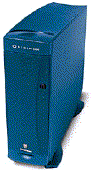 Radical in the
Origin 200 Radical in the
Origin 200
Updated: July 7th, 1998
Introduction
The SGI built Digital Audio Option PCI card
(aka Radical, marketing code PCI-AUD-8C) is now supported with the
introduction of the Origin
200 QC (Quick Cache) server. The Radical will plug into the older
Origin 200's PCI slots and work for the most part even though it
is not supported. The only requirement is that you load certain patches on top of Irix 6.4. The reason
that this combination of Radical and O200 is so late in coming is
because the initial design of the PCI motherboard did not include
support for what is known as the feature connector. The
connector was left out of the original O200 PCI motherboard because it
blocked air flow and added extra cost to the system which was not
originally targeted for audio serving. The good news is that the new
Origin 200 QC (Quick Cache) now fully supports Radical!
Feature Connector
This feature connector is an extra 6 pin edge connector
that is situated between the PCI connector and the rear connector
metalwork. The connector conveys three synchronizing signals to the
card to support realtime features such as UST (unadjusted system time)
and Ksync (Kitchen Sync). The UST Clock signal is the most critical of
the three. In the O200, it is a 1.25 MHz global clock that feeds the
UST counters in the HUB ASICS. In other SGI platforms such as Octane
and Origin 2000, this signal is fed to all I/O slots so that digital
media hardware will have a common clock to increment their UST
counters. Using this clock insures that the counters in the digital
media hardware will be consistent with the counters in the HUB ASICS
(all of which can be accessed from user software). The Ksync signals
provide a clean way of piping Video Sync around inside the system
instead of plumbing it externally. Nice, but not as essential as the
UST Clock.
Life without the Feature Connector
Radical was designed to function without this feature connection
because it was known that the O2 was not going to
support this connection either. So, in the case where the Radical finds
its signals floating, the hardware substitutes the 33 MHz PCI clock for
UST clock. The audio driver senses this on startup and programs the on
board dividers appropriately to make the UST count proceed at a rate
very close to HUB clock but drifting with respect to it.
It is less critical in the O2 because there is no
way of plugging more than one PCI card in to it. But in a two module
O200, you can plug in six Radical cards! In order to support audio
sample accurate sync between radical cards, the UST counters must be
clocked from the same source. So, in a one module O200, there is no
problem since all three cards are being clocked from the same PCI
clock. In a two module O200, each module has its own PCI clock, so
sample accurate sync is dependent on the drift between these two
separate clocks and therefore can not be guaranteed.
In summary, if you can meet the criteria
below, then you will have no problems with older O200s and older
Radical cards:
-
You can achieve sample accurate sync if you can
-
operate with 3 or less Radical cards AND
-
you can keep all Radicals in the same module AND
-
you do not need to sync this audio with video or tserialio.
OR
-
If you have no need for sample accuracy between audio devices and you
do not need to sync this audio with video or tserialio, you will be
fine.
If you do use a Radical in these older systems, you will get the
following message on the console whenever you start up the system:
               PCI Digital Audio I/O option feature connector not detected!
               Be sure that the feature connector is properly installed.
               Note that IP29 processor modules before 030-1244-001 rev A
               do not support the PCI Digital Audio I/O option.
Do not fear. It will still work, but beware of the caveats mentioned
above.
The Fix
Even though most of the applications will work fine because they fit
the above successful criteria, the engineers at SGI were not satisfied
and proceeded to fix the issues. A new version of the IP29 motherboard
was spun (known internally as the "media ready" IP29) along
with new versions of the PCI backplane and Radical card to accommodate
a connection scheme better suited to the O200's internal construction.
A small AMP modu connector was added to both the Radical card and the
PCI backplane to receive a short cable between them which connects the
UST clock and Ksync signals. The new Radical card still has the old
style edge connector as well as the new so it can work in all
platforms. The marketing code was thus changed to PCI-AUD-8C-ALL to
indicate this.
Although it is unsupported, you can use a kluge cable to connect old -001 Radical cards
with the new O200.
Even though this connector has been shipping in O200s for a while now,
Radical is not officially supported on O200s earlier than the O200QC
(Quick Cache). This is because SGI management wanted to reduce the
spares needed in the field.
Below is a matrix showing the various part numbers and the support you
can expect for them.
| O200 board set-----> |
Old O200 |
Newer O200 |
O200QC |
| Radical Card |
IP29 030-1025-00x
PCI 030-1026-001
1CPU 030-1032-001
or 2CPU 030-1027-001 |
IP29 030-1244-001
PCI 030-1026-002
1CPU 030-1032-001
or 2CPU 030-1027-001 |
IP29 030-1244-001
PCI 030-1026-002
1CPU 030-1032-001
or 2CPU 030-1027-002 |
| 030-0950-001 (PCI-AUD-8C) |
C |
C |
C |
| 030-0950-002 (PCI-AUD-8C-ALL) |
C |
B |
A |
A Fully supported.
B Fully functional but not
supported.
C Will
work, but UST is clocked from PCI clock and therefore drifts with
respect to system UST and Radicals in other modules. And, sorry, no
ksync features.
D Will explode in flames!
Call 911.
You can use the hinv -m command to see what particular assemblies
your system has. The beginning of the rather verbose output looks like
this:
    PIMM_2XT5_2M Board: barcode GBX621     part 013-2284-002 rev  A
            IP29 Board: barcode GBX997     part 030-1244-001 rev  H
The first is the Processor module (or PIMM). Any PIMM will work with
Radical. The second is the IP29 motherboard. The 1244 is the one that
has the digital media support for UST clock and ksync. The 1025 does
not. Unfortunately, the PCI backplane does not appear in this list
since it does not have a NIC. You have to actually look inside to see
what PCI backplane you have. The 1026-002 is easily identified by three
6 pin headers along side the PCI connectors. The 1026-001 does not have
these headers.
Gotcha!
On some rare occasions, I have seen 1025 motherboards attached to
1026-002 PCI backplanes! This is very bad since, by looking at
the PCI backplane, you think you have a "media ready" O200,
so, you connect the cable. The Radical's hardware detects that you have
connected the cable and switches away from the PCI clock to the
non-existent UST clock and is hence not clocked. If you
fall into this unfortunate trap, the Rad driver will complain at
startup like this:
PCI Digital Audio I/O option UST not incrementing!
Possible cause: incompatible versions of IP29 and PCI mother boards.
Or just...
RAD UST not incrementing
And, none of the audio applications that use UST will work properly.
Solution: Remove the cable for C
support, or get 1244 motherboard for B
or A support.
Please direct comments about this paper to reed@sgi.com.
|
