|
Video Playback on the 320
and 540
visual workstations
QuickTime
Overview
The 320 and 540 ship with a playback
component in QuickTime (QT). This component, known as the Video Output,
allows a QT movie to be played back to a video output jack. The video output
component controls the setting and ownership of the video output, and instructs
QT to use our decompressor component as the last one in the chain to the
final destination of a video output jack.
Supported Application and Example Program
When QuickTime is selected in the general
information dialog, a QuickTime movie is only played back to the
source and destination windows. To have your SGI QuickTime CODEC video
clips play on the NTSC/PAL monitor instead of your desktop VGA monitor,
you will need to add a setting to Premiere's initialization file.
Make sure you have Premiere 5.1 or later.
1. In the Premiere folder (default path
is C:/ program files/adobe/premiere 5.1), open the file "Prem50.ini" if
it exists. If the file does not exist, open any text editing program, such
as WordPad, and create a new empty text file named "Prem50.ini"
2. Add the following text to the file.
Capitalization and carriage returns are important.
[proxy]
use_video_out='SGVO'
3. Save the file into the Premiere application
folder and restart Premiere.
IMPORTANT: With this setting turned on,
video clips using SGI QuickTime CODECS will play to the NTSC/PAL monitor
only; the VGA monitor will not update since the video is being redirected.
You will only get still frame updates in Premiere's monitor and clip windows
when the video is not playing and you toggle window focus.
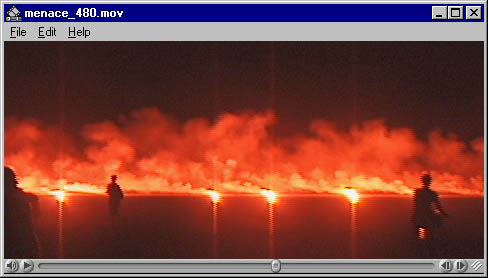
The QT
video output player (QuickTime 4 users need a update found in the
tools section) is an example program to play a movie to the video output
jack. This example was modified from Apple's simple player source
code. It behaves very much like the QuickTime movieplayer. But instead
of sending the video to the screen, it sends the video to the video output
jack. Once you open a QuickTime movie inside the QT video output player
window, the SGI QuickTime Video Output Control Panel will pop up for you
to choose the video output jack and the video timing. After you click Ok
or Cancel button in the control panel, the movie will be sent to the video
output jack once you click the play button at the bottom left corner of
the main window.
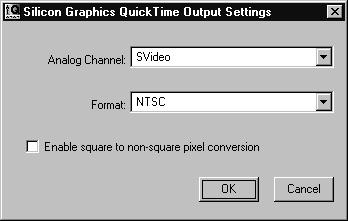
SGI QuickTime Video Output Control
Panel
-
Analog channel: SVideo and Composite
(The base configuration of 320 and 540)
-
Digital channel: Serial Digital
1 and Serial Digital 2
(The SD1100 option for 540)
-
NTSC
(CCIR601 525 video timing)
-
PAL
(CCIR601 625 video timing)
-
Enable Square to Non-square conversion
-
If the check box is checked, a movie in square
size (640*486 in NTSC or 768*576 in PAL) will be scaled to the non-square
CCIR601 size in the video output.
-
If the check box is not checked, a movie in
square size will be shown in the video output as its original size.
Supported Features and Formats
On 540 with SD1100 option card,
we support not only all of the functions listed in the control panel but
also simultaneous playback to two independent video channels.
-
Uncompressed Formats
|
FourCC Codes
|
Pixel Formats
|
| '2vuy' |
CbYCrY |
| 'ABGR' |
32-bit ABGR |
| 'BGRA' |
32-bit BGRA |
| 'raw ' 32-bit |
32-bit ARGB |
| 'raw ' 16-bit |
16-bit big endian RGB 555 (Mac) |
| 'L555' |
16-bit little endian RGB 555 (PC) |
| '5551' |
16-bit SGI's RGBA5551 |
| 'raw ' 8-bit |
8-bit gray |
| 'UYVY' AVI files |
CbYCrY |
| 'DIB ' AVI files |
32-bit and 16-bit BGRA |
-
Compressed Formats
|
FourCC Codes
|
File Formats
|
| 'jpeg' |
Photo JPEG |
| 'mjpa' |
Motion JPEG A |
| 'dvc ', 'dvcp' |
DV |
| 'JPEG' |
AVI Photo JPEG |
The JPEG and DV are Silicon Graphics optimized
software modules installed on all base model configurations.
Caveats and Known Bugs
-
qtvoutplayer Example Program
-
The video doesn't send to the screen window.
-
Opening another movie file requires closing
the current program and re-running it again.
Video for Windows
Overview
Video for Windows (VFW) does not
specify a video output architecture like QuickTime does. However,
a de facto standard for video output implementation evolved where
video output is done through video decompression modules.
Windows recognizes some RGB formats as
uncompressed and most other formats as "compressed". VFW Applications
that play compressed AVI files to the computer screen call the video decompression
modules to decompress the data to RGB. Since most PC video
boards capture in compressed formats, they often implement their modules
to send the data to the video output jack while decompressing.
SGI has several decompression
modules for decompressing AVI files in Motion JPEG, Photo JPEG, and 16-bit
UYVY formats. Currently, only the UYVY module plays back to video
output. The following discussion pertains to the UYVY module only.
Note that SGI's quicktime output component
supports playing back AVI files as well as QuickTime MOV files, so if the
user needs to play back Photo JPEG AVI files to video output, he/she can
do so using QuickTime applications.
Implementation
VFW applications send messages
to the modules to perform decompression, one message per video frame.
There are two types of messages: ICM_DECOMPRESS & ICM_DRAW. The
first is where Windows is responsible for drawing the decompressed buffer
to the computer screen. The second is where the application instructs
the decompressor module to do the drawing directly. The UYVY module
sends the data to the output jack on the DRAW messages only. Therefore,
any application that calls the DRAW messages can play UYVY AVI files to
video output.
We do not play to video out on DECOMPRESS
messages mainly because Windows, which is responsible for drawing to the
screen in these cases, does not do it in real time, causing video output
to drop frames.
-
Why do some applications play to video out
while others do not?
One side effect of not playing
to video out on DECOMPRESS messages is that applications which do not use
the DRAW messages cannot play video to the output jack. Unfortunately,
because there is no standard on which message to use, applications perform
differently from each other, and differently on different video boards.
-
Applications that we have tested
Media Player (mplay32.exe), which
ships with standard Windows NT 4.x, can send the AVI file video output.
However, we found that the version shipped with the DirectX Media SDK has
better file I/O performance. Go to the DirectX
page to get the SDK.
Adobe Premiere 5.x uses both DECOMPRESS
and DRAW messages. It uses the DRAW message while playing AVI files
from the timeline, which causes the video to be sent to the output.
III. Features
-
VFW Video Output Dialog Box
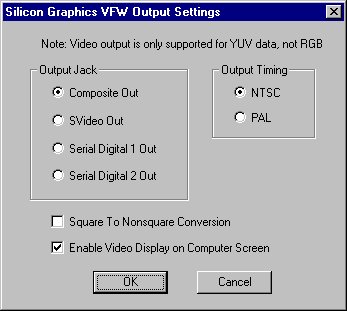
There are two ways to get to the VFW Video
output dialog box. One is to pop up the Multimedia applet in
the Control Panel, go to the Devices tab, Expand the list of Video Compression
Codecs, and click on the Properties for SGI YUV-RGB Codec. A second
way is to launch any VFW capture application and get to the VFW Settings
Dialog, and there is a Video Output button for launching the Video Output
Dialog Box.
In the dialog box, users can specify
which output jack to use and whether to turn off drawing to the screen
while playing back to video output, as well as video timing & square/non-square
pixels options, discussed in the following section.
-
Video timing & Square/Non-square Pixels
AVI files do not store video timing
information or square/non-square pixel information. Hence it is up
to the user to specify how the UYVY module should interpret the AVI file.
The user can specify these options in the video output dialog box.
-
Interleaved Frames vs. Non-interleaved Fields
The UYVY component assumes that
the AVI data is in interleaved format.
There are several restrictions
on the size of the video. The largest width supported is 768 pixels
per line, for square PAL video. The width also must be divisible
by 4 for hardware alignment. The height must be even because for
odd heights, it is ambiguous which field has the extra line. One
exception being 487 lines for NTSC, which is well-defined such that Field
1 has the extra line. The largest height supported for NTSC is 487;
for PAL, it is 576. For sizes less than full active frame, the video
is centered in the raster.
IV. Caveats and Known Bugs
-
Performance for Playing to Video Output
Internal testing shows that the
UYVY module can play to video output in real time if the video frames are
passed down from the applications fast enough. However, many applications
do not perform the file reading and parsing the video frame optimally,
thus causing frames to drop on video output. One possible solution
is disabling the Graphics Display option in the VFW output dialog.
The graphics display is not the bottleneck, but it may speed the playback
enough in some cases.
Sometimes, the same applications can play
back other AVI files to video output in real time on other PC video boards.
This is because the AVI files being played back are either JPEG or MPEG
and thus much smaller, so it does not need the file reading to be as fast.
-
Performance for Playing to Computer Screen
If the application uses DECOMPRESS
messages to draw to the computer screen, the playback might not be in real-time
even if the file reading is done in real-time. This is because the
320/540 frame buffer format does not match the Windows default RGB format,
forcing Windows to perform software byte-swapping after the decompression.
There is no workaround for this problem because Windows does not allow
the decompressing module to decompress into the frame buffer format directly.
The UYVY module also is capable
of compressing uncompressed RGB AVI files to UYVY. However, this
conversion is not optimized for speed. It is meant as a post-processing
step to allow users to convert uncompressed AVI files to UYVY in order
to play it back to video output. Users should not try to capture
BGRA and use the module to compress it while capturing; they are likely
to drop frames. The better method is to capture in 16-bit UYVY directly.
The current release supports compressing
32-bit & 16-bit default Windows RGB files; the next release will also
support 24-bit default Windows RGB files. (It is possible to specify
RGB AVI files where the order of the R, G, & B components are different
from the default. Since most applications do not use these formats,
we do not support them.)
If the user pops up the Properties
dialog for any UYVY AVI file, he/she can click on the Preview tab and play
the file to video output as well. However, we DO NOT recommend
this method. Windows does not clean up properly after user exits
the dialog, which ties up the video resources such that any subsequent
attempt to do video output might fail. (Another side effect is that
the user will not be able to modify the file because Windows thinks it
is still in use). The only workaround is to log out and log back
in.
When the user exports the rendered
movie as an AVI file, the SGI RGB-YUV Codec does not appear on the list
of compressors. This is because 3D Studio MAX is requesting an RGB
pixel format that is unsupported. The support has been added, and
the new codec will be available in the next software release.
-
Premiere 5.1 and Print-To-Video
For this and other Premiere issues,
please go to the Premiere FAQ page.
Media
SDK
We also have a Media
SDK for developers interested in adapting their applications specifically
for the 320 and 540. Please go to the SDK
page for more information.
Back
To Index |
